An introduction to controls
This tutorial provides an introduction to the subject of automatic control, including the basic elements of a control system, different control functions, and relevant terminology, with some emphasis on safety, and stability & accuracy of control.
The subject of automatic controls is enormous, covering the control of variables such as temperature, pressure, flow, level, and speed.
The objective of this Block is to provide an introduction to automatic controls. This too can be divided into two parts:
- The control of Heating, Ventilating and Air Conditioning systems (commonly known as HVAC); and
- Process control. Both are immense subjects, the latter ranging from the control of a simple domestic cooker to a complete production system or process, as may be found in a large petrochemical complex. The Controls Engineer needs to have various skills at his command - knowledge of mechanical engineering, electrical engineering, electronics and pneumatic systems, a working understanding of HVAC design and process applications and, increasingly today, an understanding of computers and digital communications. The intention of this Block is to provide a basic insight into the practical and theoretical facets of automatic control, to which other skills can be added in the future, not to transform an individual into a Controls Engineer. This Block is confined to the control of processes that utilise the following fluids: steam, water, compressed air and hot oils. Control is generally achieved by varying fluid flow using actuated valves. For the fluids mentioned above, the usual requirement is to measure and respond to changes in temperature, pressure, level, humidity and flowrate. Almost always, the response to changes in these physical properties must be within a given time. The combined manipulation of the valve and its actuator with time, and the close control of the measured variable, will be explained later in this Block. The control of fluids is not confined to valves. Some process streams are manipulated by the action of variable speed pumps or fans.
The need for automatic controls There are three major reasons why process plant or buildings require automatic controls:
- Safety - The plant or process must be safe to operate. The more complex or dangerous the plant or process, the greater is the need for automatic controls and safeguard protocol.
- Stability - The plant or processes should work steadily, predictably and repeatably, without fluctuations or unplanned shutdowns.
- Accuracy- This is a primary requirement in factories and buildings to prevent spoilage,increase quality and production rates, and maintain comfort. These are the fundamentals of economic efficiency. Other desirable benefits such as economy, speed, and reliability are also important, but it is against the three major parameters of safety, stability and accuracy that each control application will be measured. Automatic control terminology Specific terms are used within the controls industry, primarily to avoid confusion. The same words and phrases come together in all aspects of controls, and when used correctly, their meaning is universal. The simple manual system described in Example 5.1.1 and illustrated in Figure 5.1.1 is used to introduce some standard terms used in control engineering. Example 5.1.1 A simple analogy of a control system In the process example shown (Figure 5.1.1), the operator manually varies the flow of water by opening or closing an inlet valve to ensure that:
- The water level is not too high; or it will run to waste via the overflow.
- The water level is not too low; or it will not cover the bottom of the tank. The outcome of this is that the water runs out of the tank at a rate within a required range. If the water runs out at too high or too low a rate, the process it is feeding cannot operate properly. At an initial stage, the outlet valve in the discharge pipe is fixed at a certain position. The operator has marked three lines on the side of the tank to enable him to manipulate the water supply via the inlet valve. The 3 levels represent:
- The lowest allowable water level to ensure the bottom of the tank is covered.
- The highest allowable water level to ensure there is no discharge through the overflow.
- The ideal level between 1 and 2.
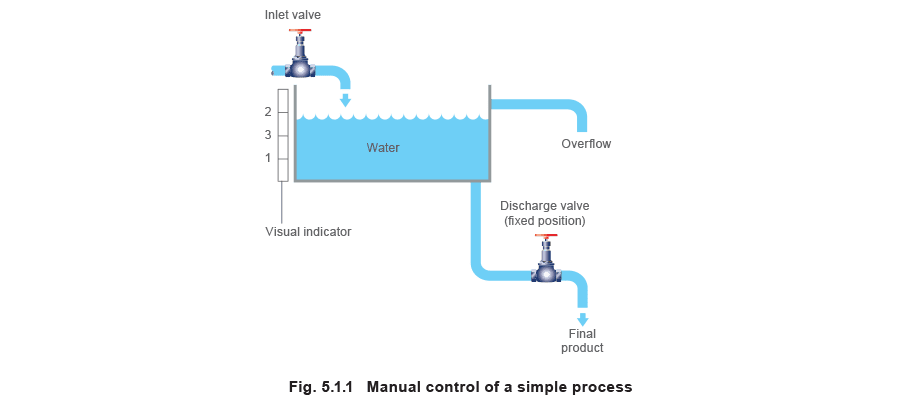
The Example (Figure 5.1.1) demonstrates that:
- The operator is aiming to maintain the water in the vessel between levels 1 and 2. The water level is called the Controlled condition.
- The controlled condition is achieved by controlling the flow of water through the valve in the inlet pipe. The flow is known as the Manipulated Variable, and the valve is referred to as the Controlled Device.
- The water itself is known as the Control Agent.
- By controlling the flow of water into the tank, the level of water in the tank is altered. The change in water level is known as the Controlled Variable.
- Once the water is in the tank it is known as the Controlled Medium.
- The level of water trying to be maintained on the visual indicator is known as the Set Value (also known as the Set Point).
- . The water level can be maintained at any point between 1 and 2 on the visual indicator and still meet the control parameters such that the bottom of the tank is covered and there is no overflow. Any value within this range is known as the Desired Value.
- Assume the level is strictly maintained at any point between 1 and 2. This is the water level at steady state conditions, referred to as the Control Value or Actual Value. Note: With reference to (7) and (8) above, the ideal level of water to be maintained was at point 3. But if the actual level is at any point between 1 and 2, then that is still satisfactory. The difference between the Set Point and the Actual Value is known as Deviation.
- If the inlet valve is closed to a new position, the water level will drop and the deviation will change. A sustained deviation is known as Offset. Elements of automatic control
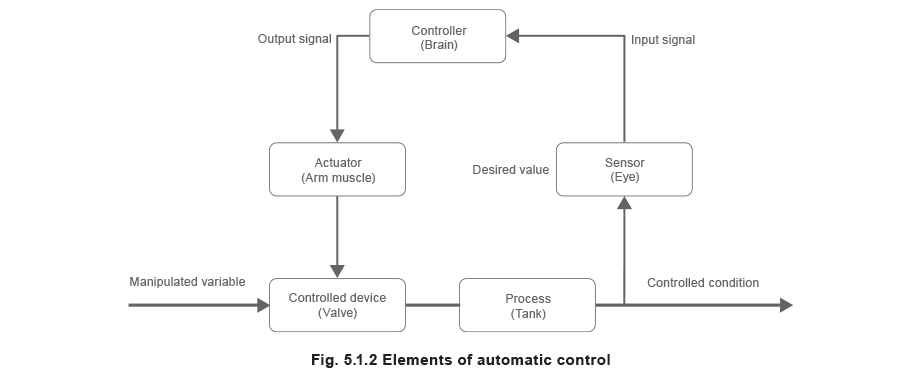
Example 5.1.2 Elements of automatic control
- The operator's eye detects movement of the water level against the marked scale indicator. His eye could be thought of as a Sensor.
- The eye (sensor) signals this information back to the brain, which notices a deviation. The brain could be thought of as a Controller.
- The brain (controller) acts to send a signal to the arm muscle and hand, which could be thought of as an Actuator.
- The arm muscle and hand (actuator) turn the valve, which could be thought of as a Controlled Device. It is worth repeating these points in a slightly different way to reinforce Example 5.1.2: In simple terms the operator's aim in Example 5.1.1 is to hold the water within the tank at a pre-defined level. Level 3 can be considered to be his target or Set Point. The operator physically manipulates the level by adjusting the inlet valve (the control device). Within this operation it is necessary to take the operator's competence and concentration into account. Because of this, it is unlikely that the water level will be exactly at Level 3 at all times. Generally, it will be at a point above or below Level 3. The position or level at any particular moment is termed the Control Value or Actual Value. The amount of error or difference between the Set Point and the Actual Value is termed deviation. When a deviation is constant, or steady state, it is termed Sustained Deviation or Offset. Although the operator is manipulating the water level, the final aim is to generate a proper outcome, in this case, a required flow of water from the tank. ****Assessing safety, stability and accuracy It can be assumed that a process typical of that in Example 5.1.1 contains neither valuable nor harmful ingredients. Therefore, overflow or water starvation will be safe, but not economic or productive. In terms of stability, the operator would be able to handle this process providing he pays full and constant attention. Accuracy is not a feature of this process because the operator can only respond to a visible and recognisable error. Summary of terminology
| Set point | The value set on the scale of the control system in order to obtain the required condition. If the controller was set at 60°C for a particular application: 60°C would be termed as the 'set point'. |
|---|---|
| Desired value | The required value that should be sustained under ideal conditions. |
| Control value | The value of the controlled condition actually maintained under steady state conditions. |
| Deviation | The difference between the set point and the control value. |
| Offset | Sustained deviation. |
| Sensor | The element that responds directly to the magnitude of the controlled condition. |
| Controlled medium | The medium being controlled by the system. The controlled medium in Fig 5.1.1 is the water in the tank. |
| Controlled condition | The physical condition of the controlled medium. The controlled condition in Fig 5.1.1 is the water level. |
| Controller | A device which accepts the signal from the sensor and sends a corrective (or controlling) signal to the actuator. |
| Actuator | The element that adjusts the controlled device in response to the signal from a controller. |
| Controlled device | The final controlling element in a control system, such as a control valve or variable speed pump. |
There are many other terms used in Automatic Controls; these will be explained later in this Block.
Elements of a temperature control system ****Example 5.1.1 depicted a simple manual level control system. This can be compared with a simple temperature control example as shown in Example 5.1.3 (manually controlled) and Figure 5.1.3. All the previous factors and definitions apply. Example 5.1.3 Depicting a simple manual temperature control system The task is to admit sufficient steam (the heating medium) to heat the incoming water from a temperature of T1; ensuring that hot water leaves the tank at a required temperature of T2.
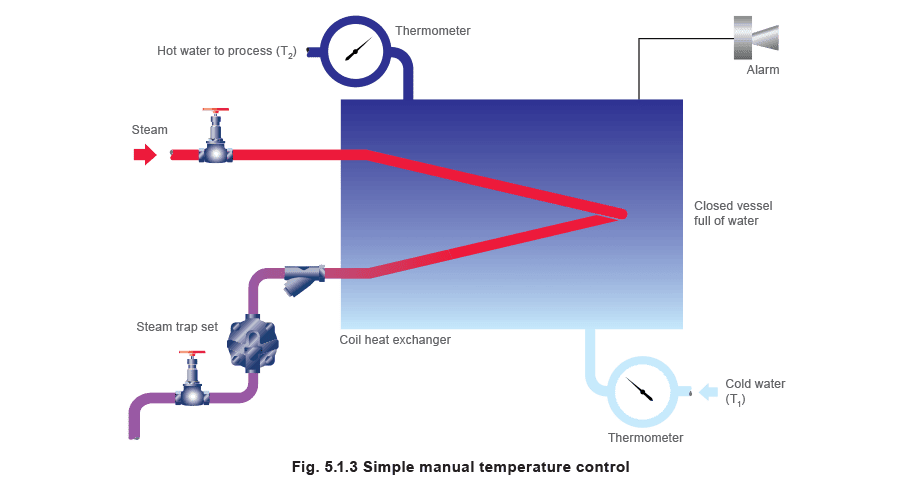
Assessing safety, stability and accuracy Whilst manual operation could probably control the water level in Example 5.1.1, the manual control of temperature is inherently more difficult in Example 5.1.3 for various reasons.
If the flow of water varies, conditions will tend to change rapidly due to the large amount of heat held in the steam. The operator's response in changing the position of the steam valve may simply not be quick enough. Even after the valve is closed, the coil will still contain a quantity of residual steam, which will continue to give up its heat by condensing. Anticipating change Experience will help but in general the operator will not be able to anticipate change. He must observe change before making a decision and performing an action.
This and other factors, such as the inconvenience and cost of a human operator permanently on duty, potential operator error, variations in process needs, accuracy, rapid changes in conditions and the involvement of several processes, all lead to the need for automatic controls.
With regards to safety, an audible alarm has been introduced in Example 5.1.3 to warn of overtemperature - another reason for automatic controls. Automatic control A controlled condition might be temperature, pressure, humidity, level, or flow. This means that the measuring element could be a temperature sensor, a pressure transducer or transmitter, a level detector, a humidity sensor or a flow sensor.
The manipulated variable could be steam, water, air, electricity, oil or gas, whilst the controlled device could be a valve, damper, pump or fan.
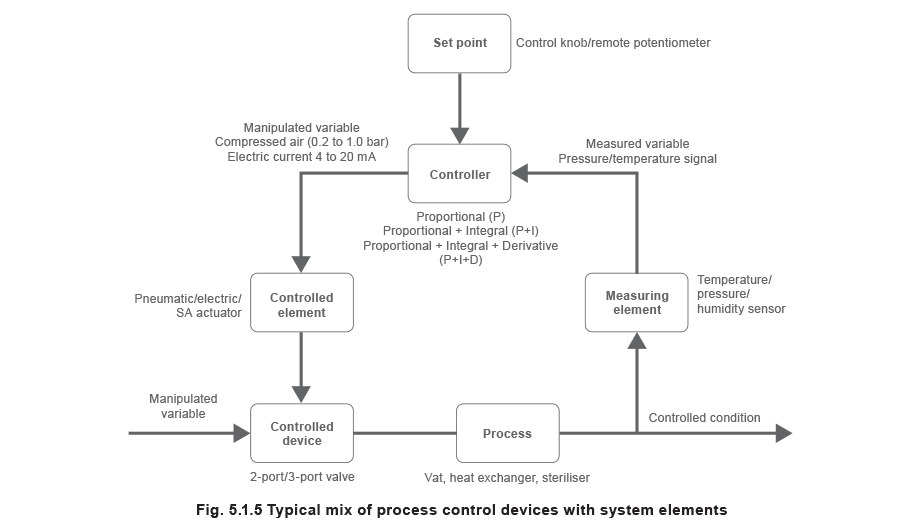
For the purposes of demonstrating the basic principles, this Module will concentrate on valves as the controlled device and temperature as the controlled condition, with temperature sensors as the measuring element. Components of an automatic control Figure 5.1.4 illustrates the component parts of a basic control system. The sensor signals to the controller. The controller, which may take signals from more than one sensor, determines whether a change is required in the manipulated variable, based on these signal(s). It then commands the actuator to move the valve to a different position; more open or more closed depending on the requirement.
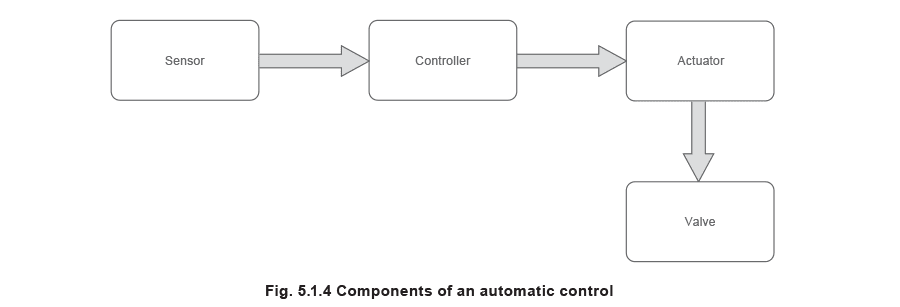
Controllers are generally classified by the sources of energy that power them, electrical, pneumatic, hydraulic or mechanical.
An actuator can be thought of as a motor. Actuators are also classified by the sources of energy that power them, in the same way as controllers. Valves are classified by the action they use to effect an opening or closing of the flow orifice, and by their body configurations, for example whether they consist of a sliding spindle or have a rotary movement. If the system elements are combined with the system parts (or devices) the relationship between 'What needs to be done?' with 'How does it do it?', can be seen. Some of the terms used may not yet be familiar. However, in the following parts of Block 5, all the individual components and items shown on the previous drawing will be addressed.