

Fluids and Flow
Users may wish to measure the flow of steam to help with plant efficiency, energy efficiency, process control or costing purposes. This tutorial considers the characteristics of flowing fluids and the basic requirements for good steam metering practice.
'When you can measure what you are speaking about and express it in numbers, you know something about it; but when you cannot measure it, when you cannot express it in numbers, your knowledge is of a meagre and unsatisfactory kind'. William Thomson (Lord Kelvin) 1824 - 1907
Introduction
Introduction
Many industrial and commercial businesses have now recognised the value of:
- Energy cost accounting.
- Energy conservation.
- Monitoring and targeting techniques. These tools enable greater energy efficiency. Steam is not the easiest media to measure. The objective of this Block is to achieve a greater understanding of the requirements to enable the accurate and reliable measurement of steam flowrate. Most flowmeters currently available to measure the flow of steam have been designed for measuring the flow of various liquids and gases. Very few have been developed specifically for measuring the flow of steam. Spirax Sarco wishes to thank the EEBPP (Energy Efficiency Best Practice Programme) of ETSU for contributing to some parts of this Block..
Why measure steam?
Why measure steam?
Steam flowmeters cannot be evaluated in the same way as other items of energy saving equipment or energy saving schemes. The steam flowmeter is an essential tool for good steam housekeeping. It provides the knowledge of steam usage and cost which is vital to an efficiently operated plant or building. The main benefits for using steam flowmetering include:
- Plant efficiency.
- Energy efficiency.
- Process control.
- Costing and custody. Plant efficiency ****A good steam flowmeter will indicate the flowrate of steam to a plant item over the full range of its operation, i.e. from when machinery is switched off to when plant is loaded to capacity. By analysing the relationship between steam flow and production, optimum working practices can be determined. The flowmeter will also show the deterioration of plant over time, allowing optimum plant cleaning or replacement to be carried out. The flowmeter may also be used to:
This may lead to changes in production methods to ensure economical steam usage. It can also reduce problems associated with peak loads on the boiler plant. Energy efficiency Steam flowmeters can be used to monitor the results of energy saving schemes and to compare the efficiency of one piece of plant with another. Process control The output signal from a proper steam flowmetering system can be used to control the quantity of steam being supplied to a process, and indicate that it is at the correct temperature and pressure. Also, by monitoring the rate of increase of flow at start-up, a steam flowmeter can be used in conjunction with a control valve to provide a slow warm-up function. Costing and custody Steam flowmeters can measure steam usage (and thus steam cost) either centrally or at individual user points. Steam can be costed as a raw material at various stages of the production process thus allowing the true cost of individual product lines to be calculated. To understand flowmetering, it might be useful to delve into some basic theory on fluid mechanics, the characteristics of the fluid to be metered, and the way in which it travels through pipework systems.
Fluid characteristics
Fluid characteristics
Every fluid has a unique set of characteristics, including:
- Density.
- Dynamic viscosity
- Kinematic viscosity.
Density
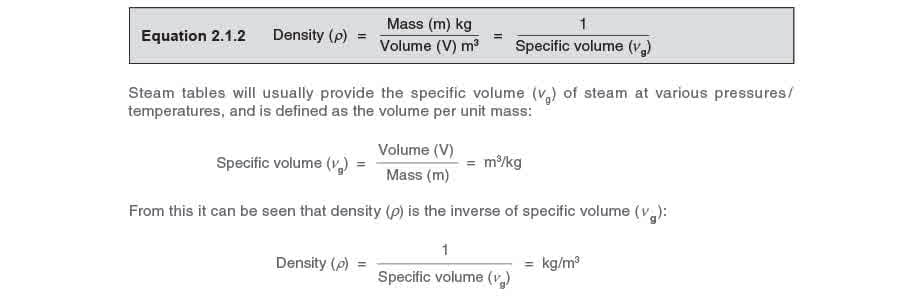
This has already been discussed in Block 2, Steam Engineering Principles and Heat Transfer, however, because of its importance, relevant points are repeated here.
Density (ρ) defines the mass (m) per unit volume (V) of a substance (see Equation 2.1.2).
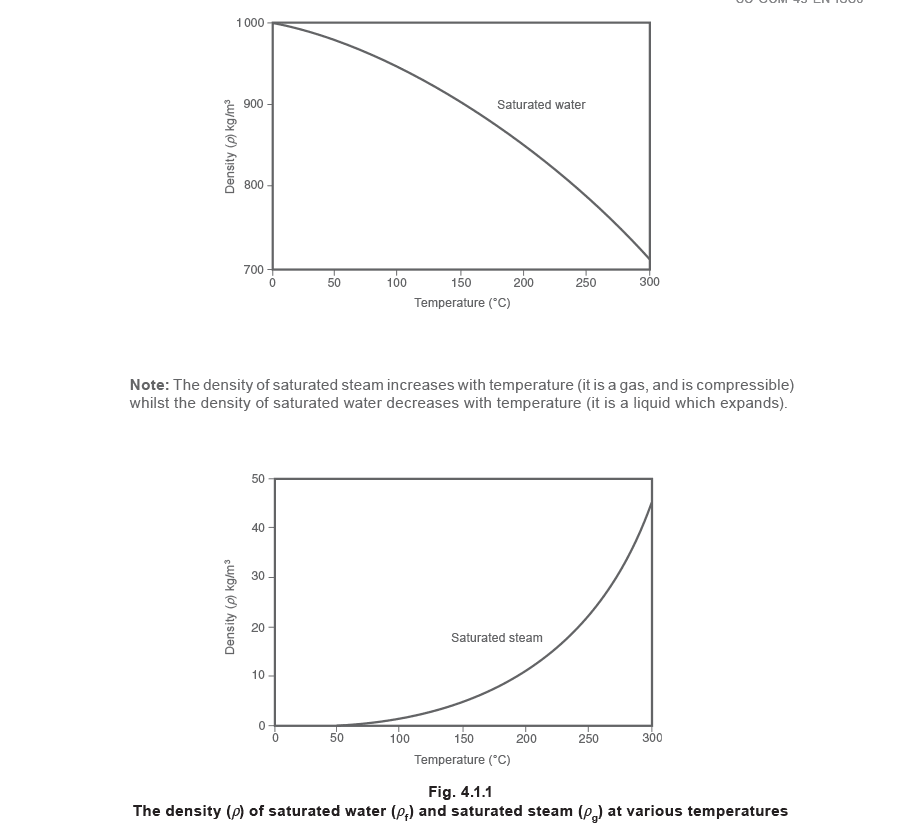
 The density of both saturated water and saturated steam vary with temperature. This is illustrated in Figure 4.1.1.
 Dynamic viscosity
****This is the internal property that a fluid possesses which resists flow. If a fluid has a high viscosity (e.g. heavy oil) it strongly resists flow. Also, a highly viscous fluid will require more energy to push it through a pipe than a fluid with a low viscosity.
There are a number of ways of measuring viscosity, including attaching a torque wrench to a paddle and twisting it in the fluid, or measuring how quickly a fluid pours through an orifice.
A simple school laboratory experiment clearly demonstrates viscosity and the units used:
A sphere is allowed to fall through a fluid under the influence of gravity. The measurement of the distance (d) through which the sphere falls, and the time (t) taken to fall, are used to determine the velocity (u).
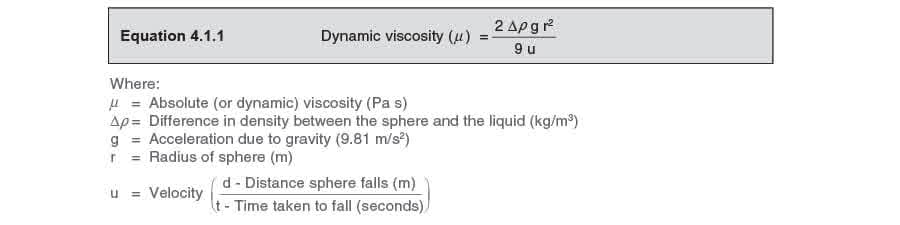
The following equation is then used to determine the dynamic viscosity:
Dynamic viscosity
****This is the internal property that a fluid possesses which resists flow. If a fluid has a high viscosity (e.g. heavy oil) it strongly resists flow. Also, a highly viscous fluid will require more energy to push it through a pipe than a fluid with a low viscosity.
There are a number of ways of measuring viscosity, including attaching a torque wrench to a paddle and twisting it in the fluid, or measuring how quickly a fluid pours through an orifice.
A simple school laboratory experiment clearly demonstrates viscosity and the units used:
A sphere is allowed to fall through a fluid under the influence of gravity. The measurement of the distance (d) through which the sphere falls, and the time (t) taken to fall, are used to determine the velocity (u).
The following equation is then used to determine the dynamic viscosity:
 There are three important notes to make:
- The result of Equation 4.1.1 is termed the absolute or dynamic viscosity of the fluid and is measured in pascal seconds. Dynamic viscosity is also expressed as 'viscous force.'
- The physical elements of the equation give a resultant in kg/m, however, the constants (2 and 9) take into account both experimental data and the conversion of units to pascal seconds (Pa s).
- Some publications give values for absolute viscosity or dynamic viscosity in centipoise (cP), e.g.: 1 cP = 10-3 Pa s
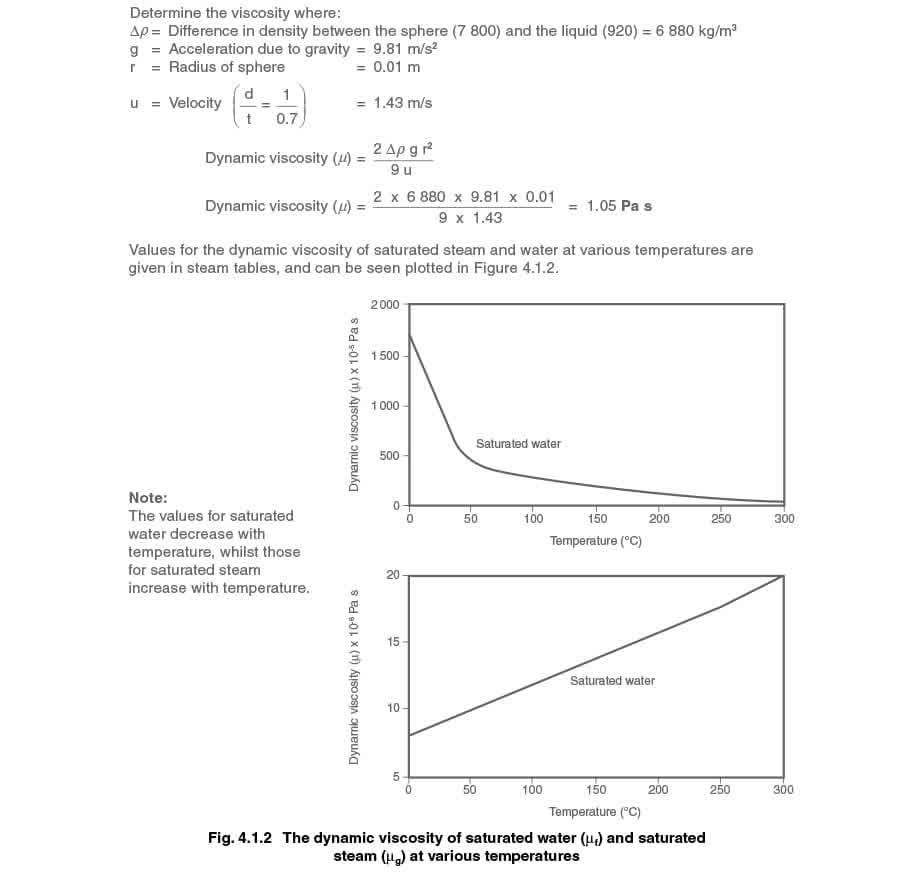
Example 4.1.1
It takes 0.7 seconds for a 20mm diameter steel (density 7 800 kg/m3) ball to fall 1 metre through oil at 20°C (density = 920 kg/m3).
Kinematic viscosity
This expresses the relationship between absolute (or dynamic) viscosity and the density of the fluid (see Equation 4.1.2).
 Example 4.1.2
In Example 4.1.1, the density of the oil is given to be 920 kg/m3 - Now determine the kinematic viscosity:
Example 4.1.2
In Example 4.1.1, the density of the oil is given to be 920 kg/m3 - Now determine the kinematic viscosity:
 Reynolds number (Re)
The factors introduced above all have an effect on fluid flow in pipes. They are all drawn together in one dimensionless quantity to express the characteristics of flow, i.e. the Reynolds number (Re).
Reynolds number (Re)
The factors introduced above all have an effect on fluid flow in pipes. They are all drawn together in one dimensionless quantity to express the characteristics of flow, i.e. the Reynolds number (Re).
