Thermostatic Steam Traps
Thermostatic traps operate in response to the surrounding steam temperature. The operation and benefits of 3 different types are considered here - liquid expansion traps, bimetallic and balanced pressure thermostatic traps. Each operates in a different way and is suited to specific types of application.
Liquid expansion steam trap
Liquid expansion steam trap
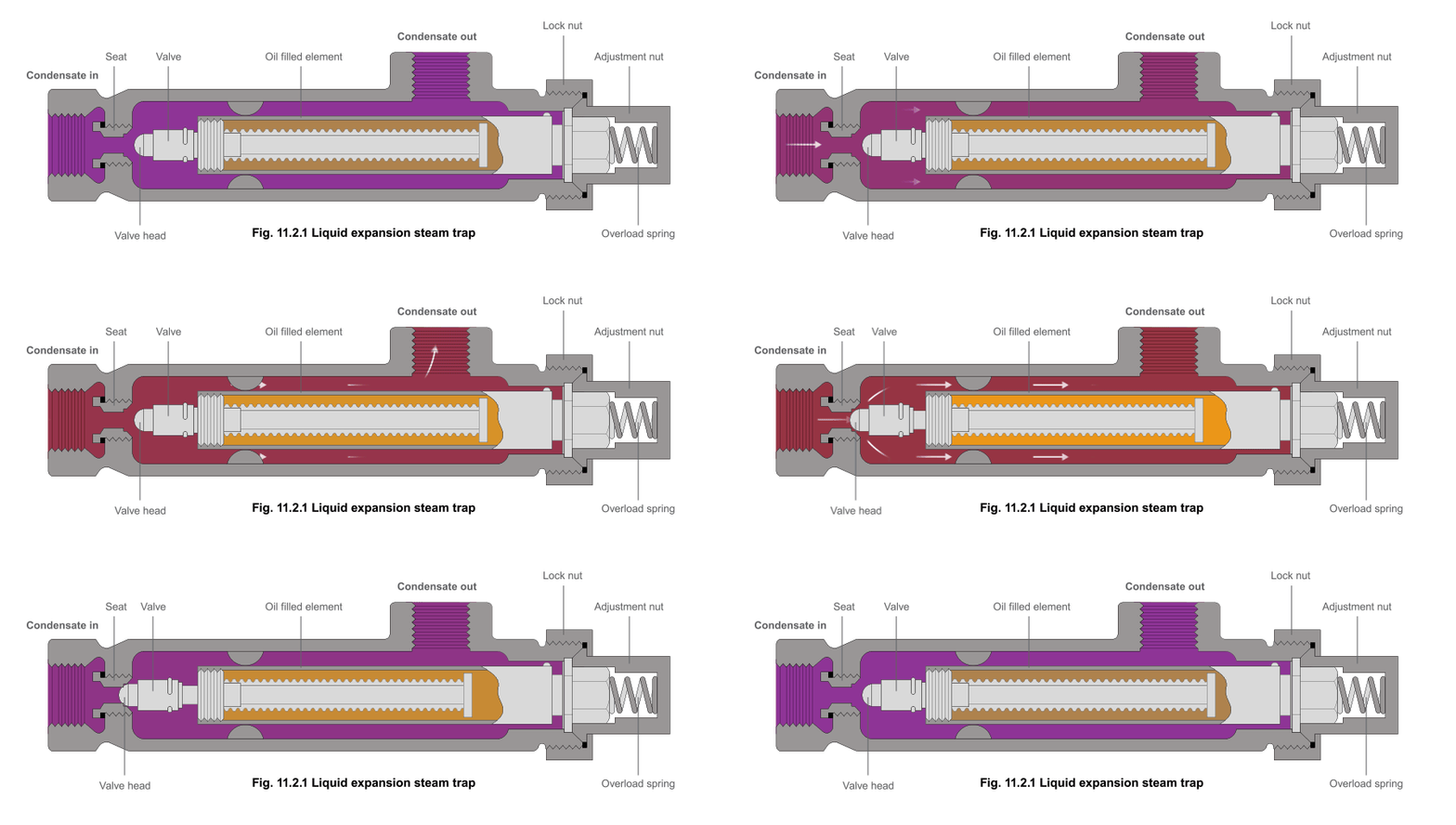
This is one of the simplest thermostatic traps and is shown in Figure 11.2.1. An oil filled element expands when heated to close the valve against the seat. The adjustment allows the temperature of the trap discharge to be altered between 60°C and 100°C, which makes it ideally suited as a device to get rid of large quantities of air and cold condensate at start-up.
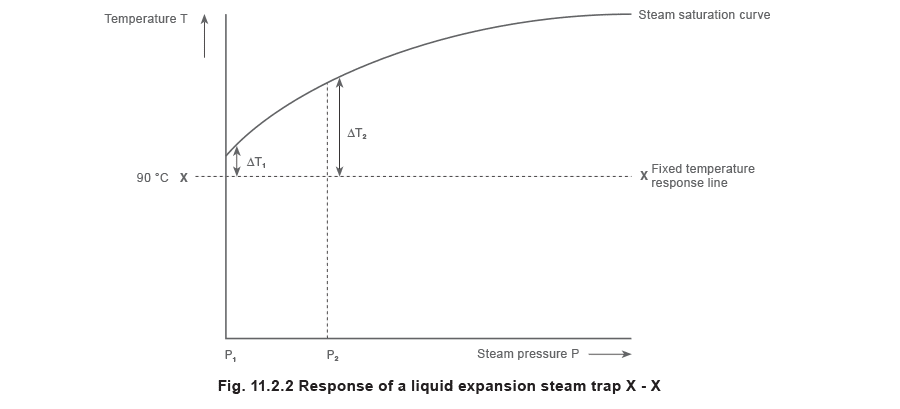
 As discussed in Module 2.2, the temperature of saturated steam varies with pressure.
Figure 11.2.2 shows the saturation curve for steam, together with the fixed temperature response line (X - X) of the liquid expansion trap, set at 90°C.
It can be seen from Figure 11.2.2 that when the pressure is at pressure P1, condensate would have to cool by only a small amount (ΔT1), and trapping would be acceptable. However, if pressure is increased to P2 then condensate has to cool more (ΔT2) to pass through the steam trap. This cooling can only occur in the pipe between the process and trap, and if the trap discharge temperature remains constant, the process will waterlog.
Typical application
Typical application
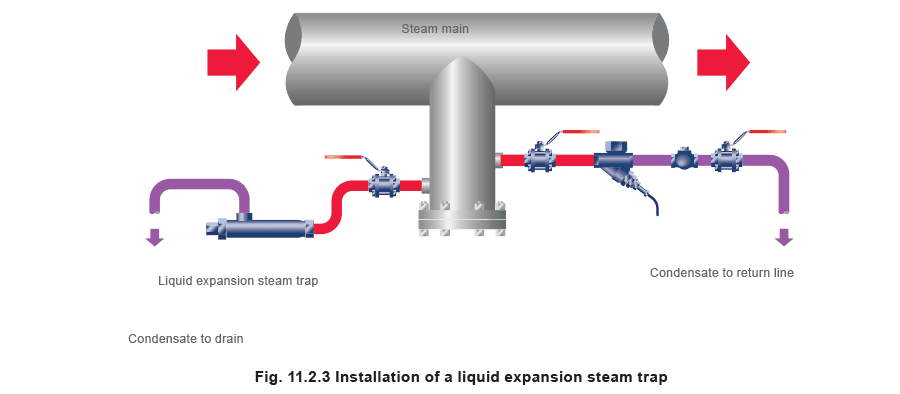
Because of its fixed temperature discharge characteristic, the liquid expansion trap may be usefully employed as a ‘shutdown drain trap’. Here, its outlet must always point upwards, as illustrated in Figure 11.2.3, to enable continuous immersion of the oil filled element. As the trap can only discharge between 60°C - 100°C it will only normally open during start-up. It can be installed alongside a mains drain trap which would normally be piped to a condensate return line.
 Advantages of the liquid expansion steam trap:
• Liquid expansion traps can be adjusted to discharge at low temperatures, giving an excellent ‘cold drain’ facility. • Like the balanced pressure trap, the liquid expansion trap is fully open when cold, giving good air discharge and maximum condensate capacity on ‘start-up’ loads. • The liquid expansion trap can be used as a start-up drain trap on low pressure superheated steam mains where a long cooling leg is guaranteed to flood with cooler condensate. It is able to withstand vibration and waterhammer conditions.
Disadvantages of the liquid expansion steam trap:
• The flexible tubing of the element can be destroyed by corrosive condensate or superheat. • Since the liquid expansion trap discharges condensate at a temperature of 100°C or below, it should never be used on applications which demand immediate removal of condensate from the steam space. • If the trap is to be subjected to freezing conditions the trap and its associated pipework must be well insulated. • The liquid expansion trap is not normally a trapping solution on its own, as it usually requires another steam trap to operate in parallel. However, it can often be used where start-up rate is not an important consideration, such as when draining small tank heating coils.
Balanced pressure steam trap
Balanced pressure steam trap
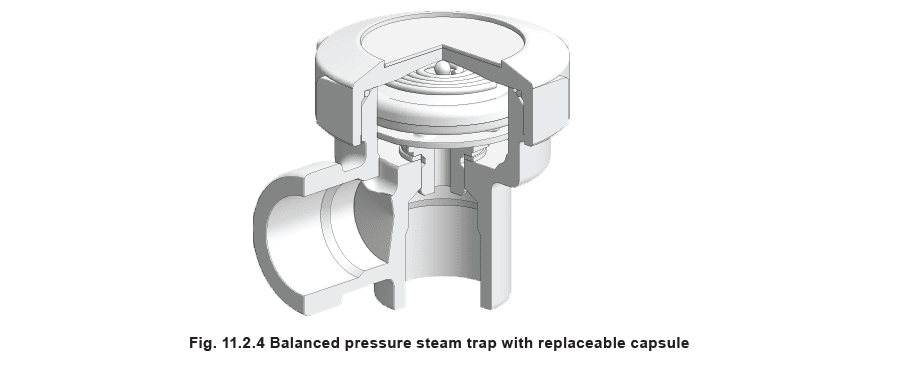
A large improvement on the liquid expansion trap is the balanced pressure trap, shown in Figure 11.2.4. Its operating temperature is affected by the surrounding steam pressure. The operating element is a capsule containing a special liquid and water mixture with a boiling point below that of water. In the cold conditions that exist at start-up, the capsule is relaxed. The valve is off its seat and is wide open, allowing unrestricted removal of air. This is a feature of all balanced pressure traps and explains why they are well suited to air venting.
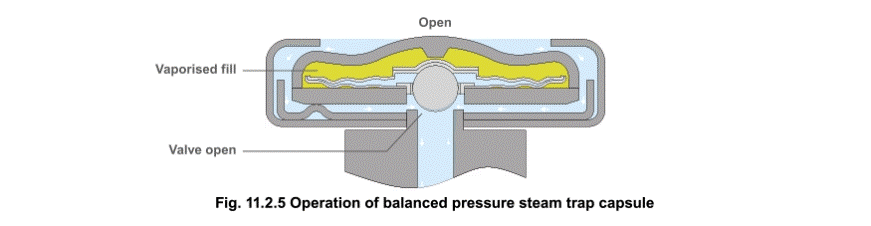
 As condensate passes through the balanced pressure steam trap, heat is transferred to the liquid in the capsule. The liquid vaporises before steam reaches the trap. The vapour pressure within the capsule causes it to expand and the valve shuts. Heat loss from the trap then cools the water surrounding the capsule, the vapour condenses and the capsule contracts, opening the valve and releasing condensate until steam approaches again and the cycle repeats (Figure 11.2.5).
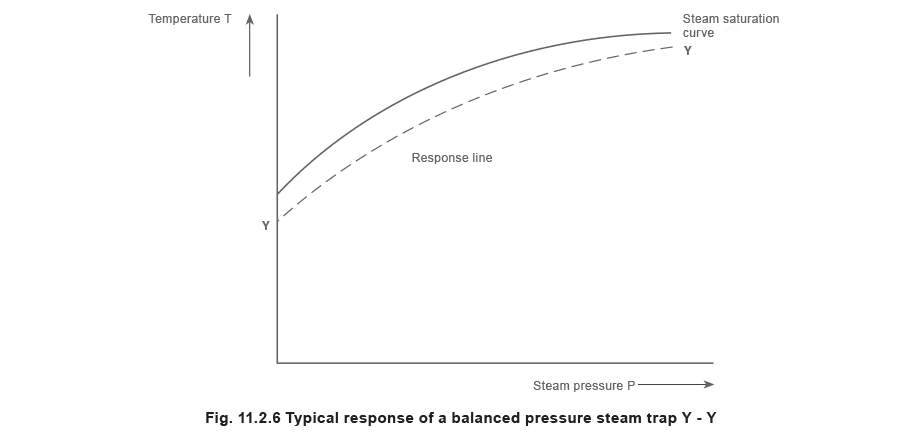
The differential below steam temperature at which the trap operates is governed by the concentration of the liquid mixture in the capsule. The 'thin-walled' element gives a rapid response to changes in pressure and temperature. The result is the response line as illustrated in Figure 11.2.6.
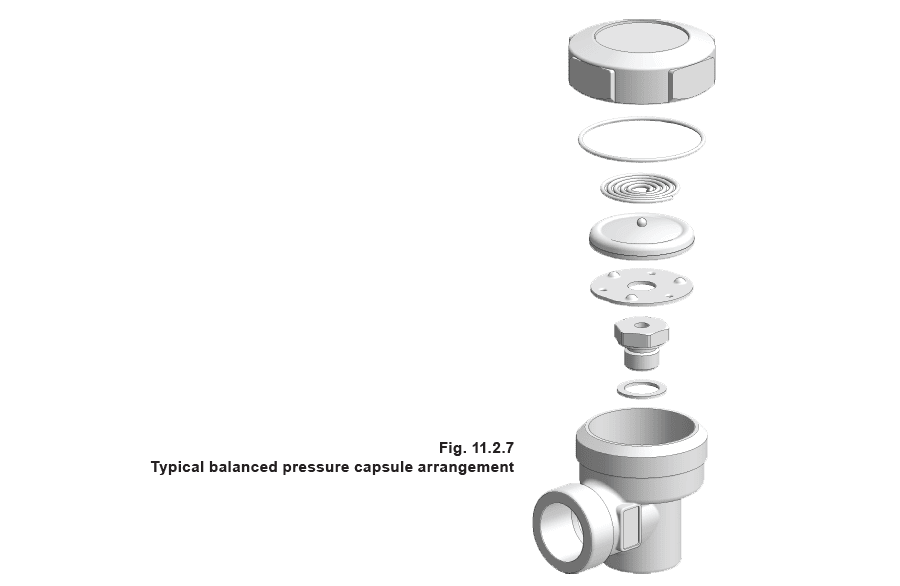
 Early bellows type elements of non-ferrous construction were susceptible to damage by waterhammer. The introduction of stainless steel elements improved reliability considerably. Figure 11.2.7 shows an exploded view of a modern balanced pressure steam trap arrangement that has considerable resistance to damage from waterhammer, superheat and corrosion.
 Advantages of the balanced pressure steam trap:
• Small, light and has a large capacity for its size. • The valve is fully open on start-up, allowing air and other non-condensable gases to be discharged freely and giving maximum condensate removal when the load is greatest. • This type of trap is unlikely to freeze when working in an exposed position (unless there is a rise in the condensate pipe after the trap, which would allow water to run back and flood the trap when the steam is off). • The modern balanced pressure trap automatically adjusts itself to variations of steam pressure up to its maximum operating pressure. It will also tolerate up to 70°C of superheat. • Trap maintenance is simple. The capsule and valve seat are easily removed, and replacements can be fitted in a few minutes without removing the trap from the line. Disadvantages of the balanced pressure steam trap:
• The older style balanced pressure steam traps had bellows which were susceptible to damage by waterhammer or corrosive condensate. Welded stainless steel capsules introduced more recently, are better able to tolerate such conditions. • In common with all other thermostatic traps, the balanced pressure type does not open until the condensate temperature has dropped below steam temperature (the exact temperature difference being determined by the fluid used to fill the element). This is clearly a disadvantage if the steam trap is chosen for an application in which waterlogging of the steam space can not be tolerated, for example; mains drainage, heat exchangers, critical tracing.
Bimetallic steam trap
Bimetallic steam trap
As the name implies, bimetallic steam traps are constructed using two strips of dissimilar metals welded together into one element. The element deflects when heated. (Figure 11.2.8):